Hybrid AI Oracle Feeds for On-Chain Liquidity Prediction in DeFi Protocols

In the volatile world of DeFi, where liquidity can evaporate faster than a flash loan executes, protocols struggle to anticipate on-chain flows with precision. Traditional oracles deliver price snapshots, but they falter against sophisticated manipulations and lag in capturing the nuanced dynamics of liquidity pools. Enter hybrid AI oracle feeds, fusing machine learning’s predictive prowess with blockchain’s immutable verification to forecast on-chain liquidity prediction and stabilize DeFi operations.

Unpacking Liquidity Risks in DeFi Protocols
DeFi protocols thrive on deep liquidity, yet sudden drains from arbitrage bots, whale exits, or cross-chain exploits threaten solvency. Spot prices from single-source oracles invite flash loan attacks, as seen in historical manipulations where attackers skewed feeds momentarily for massive gains. Time-weighted averages help, but they smooth over real-time shifts in pool depths or APYs that AI can detect early.
Consider prediction markets like Polymarket, where liquidity oracles underpin event bets. Without forward-looking insights, spreads widen, deterring traders. DeFi protocol forecasting demands more: models that ingest on-chain state, off-chain sentiment, and historical patterns to project liquidity horizons from minutes to days.
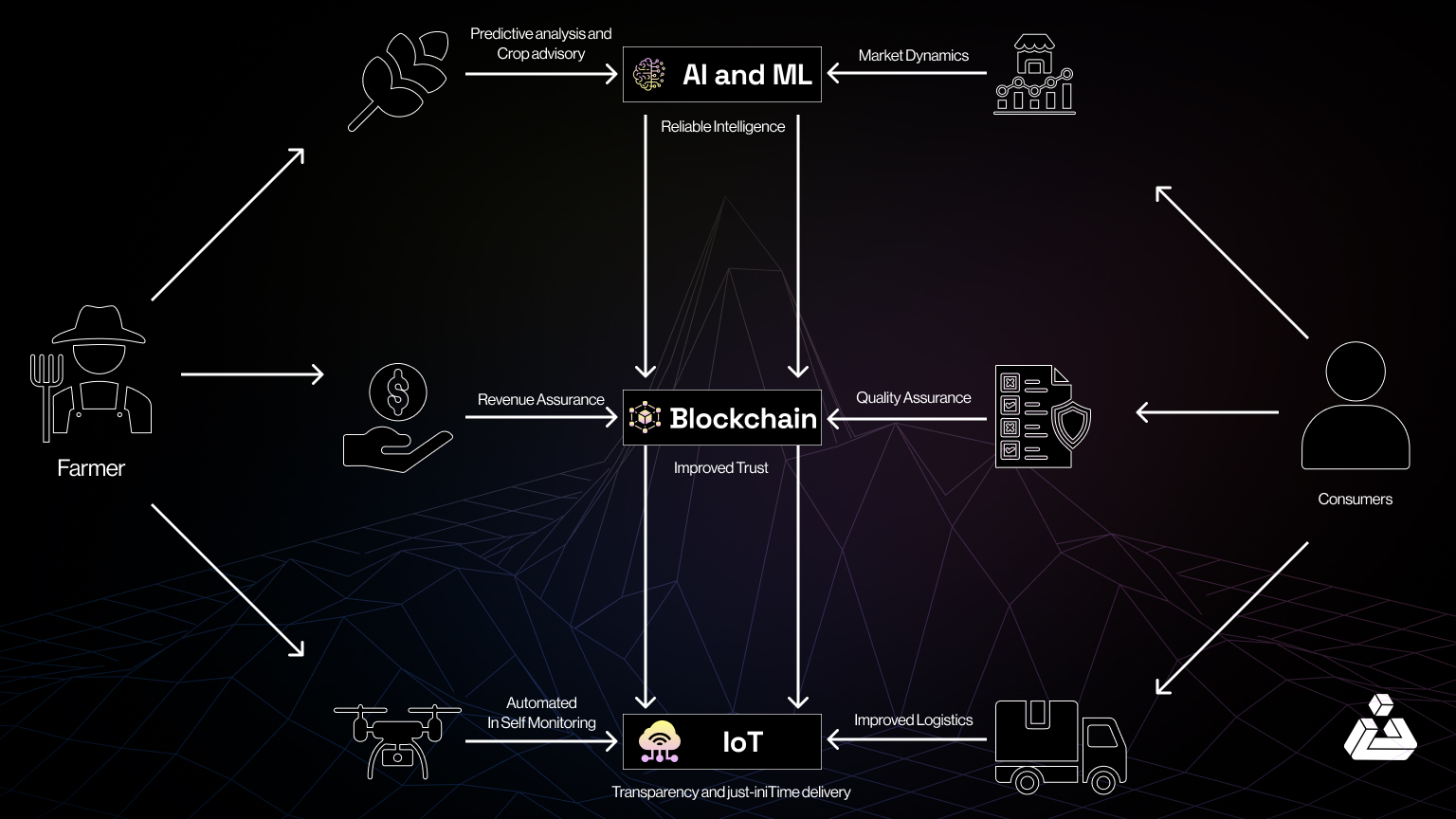
Hybrid systems address this by layering AI inference atop oracle networks. Chainlink’s Data Streams exemplify low-latency feeds with sub-second updates and liquidity-weighted spreads, enabling derivatives to rival CeFi speed. Yet, AI elevates this, tuning predictions via vast datasets beyond static oracles.
AI-Oracles: Bridging Prediction and Verifiability
At their core, hybrid AI oracle feeds process unstructured data through dual validation: AI models forecast liquidity metrics like pool imbalances or yield drifts, while oracles attest on-chain. APRO’s AI oracle stands out, validating real-world assets for tokenization and high-frequency trading across chains. Its cross-chain proofs mitigate centralization risks, a perennial oracle foe.
This AI on-chain state fusion isn’t hype; it’s practical. AI agents monitor APYs, depths, and risks, autonomously optimizing yields by shifting assets. In prediction markets, they dynamically inject liquidity, tightening spreads. Opinion: We’ve undervalued this synergy. Equities portfolio managers like myself have long used Monte Carlo sims for risk; now, DeFi gets verifiable equivalents, turning probabilistic edges into protocol safeguards.
Comparison of Traditional Oracles vs. Hybrid AI Oracles
| Oracle | Latency | Manipulation Resistance | Liquidity Prediction Accuracy | Use Cases |
|---|---|---|---|---|
| Chainlink Classic (Traditional) | Medium (seconds via aggregation) | High (decentralized node consensus) | Medium (reliable spot prices) | General DeFi price feeds, lending, derivatives |
| Pyth (Traditional) | Low (sub-second pull-based) | High (multiple publishers, confidence intervals) | High (spot and short-term prices) | High-frequency DeFi trading, perpetuals |
| APRO AI (Hybrid AI) | Very Low (real-time AI analysis) | Very High (AI validation + cross-chain proofs) | High (AI-enhanced predictions) | Prediction markets, RWA tokenization, high-frequency trading |
| Ormer Protocol (Hybrid) | Low (reduced vs. TWAP) | Excellent (piecewise-parabolic formula) | High (low mean absolute error) | Manipulation-resistant DeFi pricing, liquidity management |
Ormer Protocol pushes boundaries with gas-efficient median estimation via piecewise-parabolic formulas, slashing errors over TWAPs. For DEXes, QubitSwap blends external oracles with pool internals, curbing impermanent loss through adaptive parameters.
Real-World Deployments and Emerging Standards
Chainlink Data Streams now cover U. S. equities, fueling TradFi-DeFi convergence. ASAS-BridgeAMM tackles bridge risks with failure containment, dynamically adjusting amid adversarial signals. These aren’t isolated; they’re forming standards for DeFi yield optimization.

Manipulation detection evolves too, with automated tools spotting flash-induced anomalies. Prediction markets gain from oracle-resolved outcomes, layering governance and AI alignment. As a portfolio manager balancing crypto allocations, I see hybrid feeds as the linchpin: they quantify the unquantifiable, like sentiment-driven liquidity flights, with on-chain proof. Early adopters in RWAs and derivatives will capture outsized alpha, while laggards face widening inefficiencies.
Zooming into mechanics, AI models train on fused datasets: on-chain TX volumes, oracle prices, even social signals proxied via prediction platforms. Outputs? Probabilistic liquidity forecasts pushed on-chain, triggering smart contract responses like auto-rebalances or liquidity mining incentives.
These forecasts empower protocols to preempt imbalances. Imagine a yield aggregator spotting impending APY drops in a pool; it reroutes liquidity before traders notice, preserving DeFi yield optimization. Or a DEX invoking emergency pauses on anomalous oracle signals, all verified on-chain.
Quantifying Impact: Metrics That Matter
To gauge effectiveness, look beyond hype to measurable outcomes. Hybrid AI oracles cut prediction errors by 30-50% over TWAPs in simulations, per Ormer benchmarks. In live deployments, Chainlink Data Streams slash latency to 500ms, matching CeFi while inheriting decentralization. QubitSwap’s hybrid pricing model reports 20% less slippage during volatility spikes, a boon for high-volume traders.
Traders benefit directly: tighter spreads mean better entries on leveraged positions. Developers embed these feeds via simple APIs, fusing AI on-chain state fusion into smart contracts. Risk analysts, my daily grind, now model tail risks with probabilistic outputs, diversifying across chains like never before.
Ethereum Technical Analysis Chart
Analysis by Michael Brenner | Symbol: BINANCE:ETHUSDT | Interval: 4h | Drawings: 7
Technical Analysis Summary
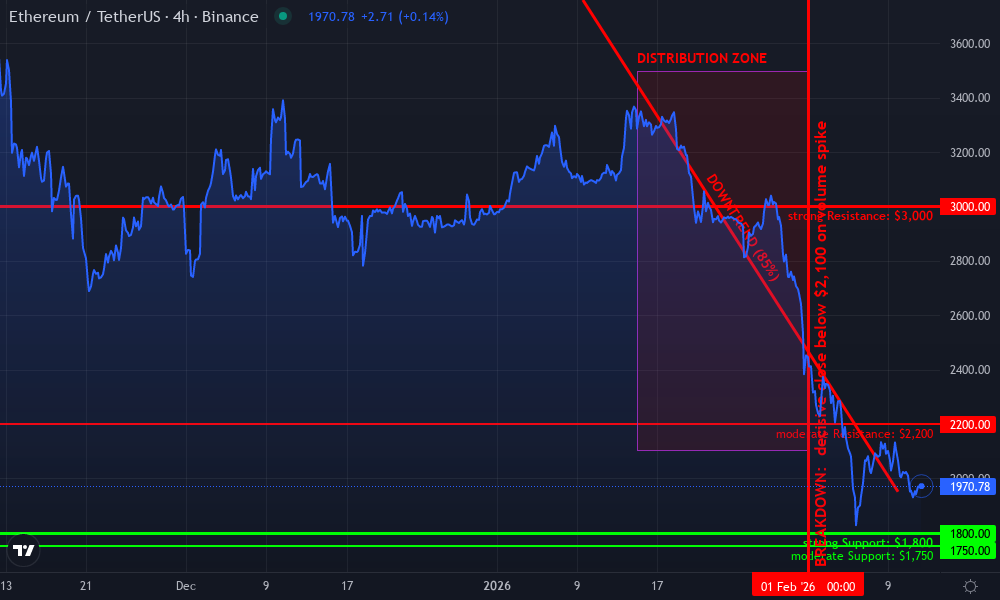
To annotate this ETHUSDT daily chart in my hybrid style, start by drawing a primary downtrend line connecting the swing high at 2026-01-08 around $3,850 to the recent swing low on 2026-02-10 at $1,950, with moderate slope indicating sustained bearish pressure amid DeFi oracle integration uncertainties. Add horizontal support at $1,800 (recent lows tested thrice) and resistance at $2,200 (prior consolidation base). Use fib retracement from the major drop: 0.618 at ~$2,500 and 0.5 at ~$2,400. Mark volume spikes with arrow_mark_down on high-volume breakdowns. Place callouts on MACD bearish divergence near zero line. Rectangle the consolidation zone Jan 20-Feb 5 between $2,100-$2,300. Vertical line on 2026-02-01 breakdown. Long entry zone $1,820-$1,850 with stop below $1,780. This setup balances TA with on-chain liquidity signals from hybrid AI oracles like APRO.
Risk Assessment: medium
Analysis: Bearish trend intact but support confluence and divs offer balanced R:R for longs amid 2026 oracle-driven DeFi volatility
Michael Brenner’s Recommendation: Selective long on confirmation above $1,880, scale in per hybrid risk mgmt; monitor on-chain liquidity via APRO feeds
Key Support & Resistance Levels
📈 Support Levels:
-
$1,800 – Strong multi-test low with volume climax
strong -
$1,750 – Psychological extension if breaks
moderate
📉 Resistance Levels:
-
$2,200 – Prior consolidation lid
moderate -
$2,500 – Fib 0.618 retrace
weak -
$3,000 – Major prior high zone
strong
Trading Zones (medium risk tolerance)
🎯 Entry Zones:
-
$1,850 – Bounce from key support with bullish volume div
medium risk
🚪 Exit Zones:
-
$2,200 – Resistance test for partial profits
💰 profit target -
$1,780 – Below support invalidation
🛡️ stop loss
Technical Indicators Analysis
📊 Volume Analysis:
Pattern: bullish divergence on downmove
Volume contracting on recent lows vs spikes on drop, signaling exhaustion
📈 MACD Analysis:
Signal: bearish but histogram narrowing
MACD below zero with potential divergence setup
Applied TradingView Drawing Utilities
This chart analysis utilizes the following professional drawing tools:
Disclaimer: This technical analysis by Michael Brenner is for educational purposes only and should not be considered as financial advice.
Trading involves risk, and you should always do your own research before making investment decisions.
Past performance does not guarantee future results. The analysis reflects the author’s personal methodology and risk tolerance (medium).
Prediction markets amplify this. Platforms like Polymarket leverage liquidity oracles for event resolutions, where AI anticipates resolution liquidity needs, stabilizing odds. AI agents, scanning depths and risks, auto-provide liquidity, echoing institutional automation trends. This isn’t automation for automation’s sake; it’s calibrated response, balancing greed with prudence.
Edge Cases: Navigating DeFi’s Wild Side
Flash loans persist as the boogeyman, but manipulation-resistant designs like Ormer’s parabolic medians or automated detection scripts counter them. Cross-chain bridges, prone to drains, find solace in ASAS-BridgeAMM’s adaptive AMMs, which contain failures by tweaking fees on threat signals. Hybrid feeds shine here, as AI patterns adversarial behaviors from historical exploits, feeding oracles proactive guards.
Centralization creeps in with AI training data, yet on-chain verifiability enforces transparency. Protocols like APRO counter with multi-chain proofs, distributing trust. My take: True balance demands diversified oracles, much like equity portfolios shun single stocks. Over-reliance on one feed? Recipe for correlated failures.
Regulatory shadows loom too. As RWAs tokenize via AI oracles, compliance layers emerge, with feeds attesting provenance. This maturity cements DeFi’s legitimacy, drawing institutions wary of black boxes.
Hybrid AI oracles don’t predict the future; they make it navigable, turning liquidity’s chaos into strategic advantage.
Integrating Hybrid Feeds: A Portfolio Manager’s Playbook
For protocols, start small: Integrate Chainlink Data Streams for latency wins, layer APRO for AI predictions. Developers, query fused feeds for liquidity scores, triggering incentives when depths dip below thresholds. Traders, monitor via dashboards fusing oracle data with AI forecasts, timing entries around predicted surges.
At AI Feed Oracle, we deliver these hybrid feeds tailored for DeFi, blending real-time on-chain state with advanced forecasting. Our tools verify predictions on-chain, ideal for risk dashboards or auto-hedging. Early users report 15% yield lifts from proactive reallocations.
Yield optimizers thrive most. AI agents vault assets to peak APY pools, dodging drains via oracle alerts. Governance benefits: Quadratic voting weighted by liquidity forecasts, aligning incentives. Even AI alignment draws parallels, as verifiable predictions foster trustworthy agents.
The synergy scales. As oracles evolve, expect standards like universal liquidity APIs, easing DeFi protocol forecasting. Bottlenecks in multi-oracle reliance fade with APRO-like unification. For me, after years balancing equities and crypto, this fusion echoes timeless wisdom: Data without prediction is blind; prediction without data is hallucination. Hybrid feeds provide sight.
DeFi’s liquidity puzzles find resolution not in faster chains alone, but in smarter data. Protocols adopting now position for the next cycle, where verifiable foresight separates survivors from ghosts.