Hybrid AI Oracle Feeds for Prediction Markets: Fusing Forecasts with On-Chain Data in DeFi

Prediction markets in DeFi have long danced on the edge of speculation, but hybrid AI oracle feeds are injecting a dose of calculated foresight. These systems blend AI’s predictive prowess with the unyielding truth of on-chain data, turning probabilistic forecasts into actionable, verifiable intelligence. As a commodities analyst who’s tracked physical asset swings for 16 years, I see clear parallels: just as weather models guide grain futures, AI forecasting on-chain data now steers crypto bets with unprecedented edge.

The magic lies in this fusion. Traditional oracles pipe in raw off-chain facts, but hybrid AI oracles layer on forward-looking analytics, volatility projections, risk scores, even nuanced event probabilities. This isn’t hype; it’s a strategic pivot for DeFi protocols hungry for DeFi risk management oracles that preempt chaos rather than react to it.
Key Benefits of Hybrid AI Oracle Feeds
-

Enhanced prediction accuracy via AI-on-chain fusion, as in Prediction Tools API publishing probabilistic forecasts and volatility projections directly on-chain.
-

Real-time risk scoring for volatile markets, enabling proactive responses like Chaos Labs’ Risk Oracles bridging data to automated DeFi risk management.
-

Verifiable outputs reducing manipulation through cryptographic proofs and multi-signature security in verifiable AI oracles like APRO’s LLM-validated feeds.
-
Support for complex events in prediction markets, handling probabilistic forecasts beyond binary outcomes, as with Chainlink integrations on Jupiter DEX.
Trailblazing Platforms Reshaping Prediction Markets
Take Prediction Tools API: it pushes AI-generated forecasts directly on-chain, arming smart contracts with preemptive signals. Volatility spikes? Contracts adjust positions before the herd panics, slashing losses in prediction markets DeFi oracles dominate. Then there’s APRO, wielding large language models and slashing penalties to validate unstructured data for real-world asset tokenization and high-frequency trading. Its blockchain-AI synergy feels like the commodities desk I knew, but turbocharged for crypto’s 24/7 grind.
Jupiter’s move on Solana exemplifies the momentum. By hooking into Chainlink oracles, it powers tamper-proof prediction markets, curbing front-running and bolstering reliability. These aren’t isolated wins; they’re part of a broader wave where verifiable AI predictions blockchain infrastructure meets DeFi’s demand for trustless edges.
Oracle Tokens Holding Steady Amid Flux
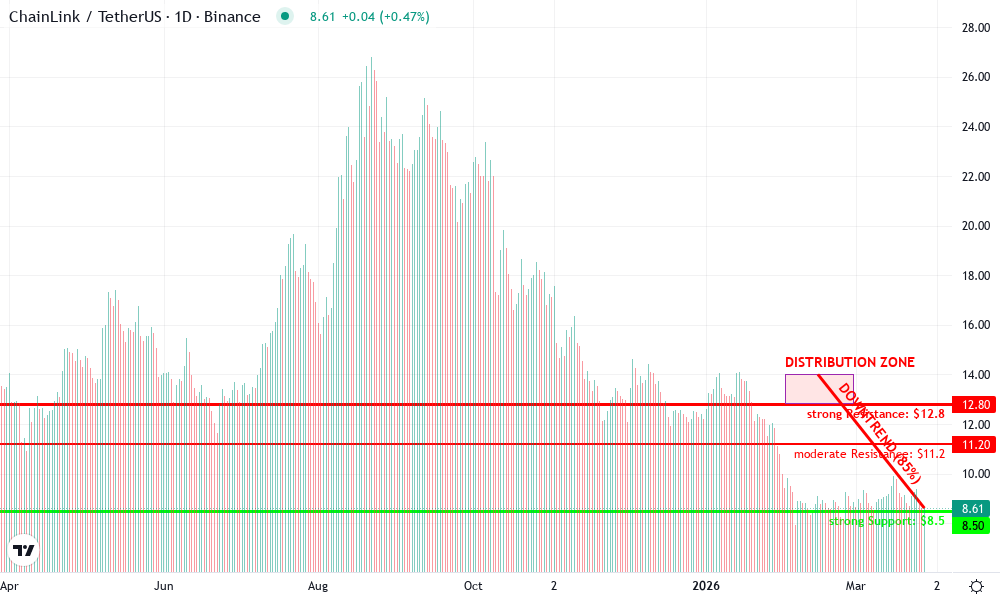
Market snapshots reveal resilience. Chainlink (LINK) hovers at $8.61, up $0.04 or 0.47% from the prior close, with an intraday high of $8.66 and low of $8.50. UMA trades at $0.396209, down $0.00782 or 1.94%, ranging from $0.405419 high to $0.390282 low. Band Protocol sits at $0.206335, off by a mere $0.00018 or 0.086%, between $0.208884 and $0.202738. These levels, as of March 28,2026, signal stability in oracle ecosystems fueling hybrid innovations.
Current Oracle Token Performance (2026-03-28)
| Oracle Token | Price (USD) | 24h Change | 24h High | 24h Low |
|---|---|---|---|---|
| Chainlink (LINK) | $8.61 | +0.47% 📈 | $8.66 | $8.50 |
| UMA (UMA) | $0.396209 | -1.94% 📉 | $0.405419 | $0.390282 |
| Band Protocol (BAND) | $0.206335 | -0.086% 📉 | $0.208884 | $0.202738 |
Yet, this steadiness underscores a deeper truth: oracle economics bridge digital networks to real-world dynamics, much like commodities tether to harvests and rigs. AI agents amplify this, deploying machine learning for autonomous risk management in DEXes and fraud detection hybrids that blockchain alone can’t match.
Navigating the Fault Lines of Integration
Don’t get complacent, these feeds aren’t flawless. Oracle manipulation lurks, with exploits testing prediction markets’ underbelly. Threshold AI oracles, distributing reasoning across nodes for multi-signature security, offer a bulwark. I’ve watched similar distributed models stabilize commodity hedges; here, they fortify DeFi against bad actors.
AI biases pose another thorn. Models trained on skewed data can amplify errors in hybrid AI oracle feeds, eroding trust. Transparency mandates, open datasets, auditable logic, are non-negotiable. Ethical guardrails ensure diverse inputs, mirroring how balanced fundamental-technical analysis has served my trend-following strategies over decades.
Verifiable AI oracles stand as the linchpin, delivering cryptographic proofs for off-chain computations that underpin trustless resolutions. This shifts prediction markets from binary yes-no bets to sophisticated arenas handling probabilistic forecasts on elections, economic indicators, even climate shifts. In my view, it’s akin to layering ensemble models over single-source commodity signals; the result is robust, manipulation-resistant intelligence that DeFi protocols crave.
Prediction Markets as DeFi’s Information Backbone
These hybrid feeds don’t just settle wagers; they morph prediction markets into native information oracles for broader DeFi composability. Imagine a lending protocol pulling crowd-sourced probabilities on default risks, or DEXes adjusting liquidity based on AI-volatility forecasts fused with on-chain flows. Chaos Labs’ risk oracles exemplify this evolution, bridging passive data to active interventions, much like AI agents in DEXes that deploy predictive analytics for real-time safeguards.
Chainlink Technical Analysis Chart
Analysis by James Quillan | Symbol: BINANCE:LINKUSDT | Interval: 1W | Drawings: 5
Technical Analysis Summary
On this LINKUSDT 1H/4H hybrid view spanning Jan-Mar 2026, overlay a Volume Profile (VPVR) confirmation with horizontal lines at key HVNs: strong resistance at $12.80 (POC cluster, fat red/green bars mid-profile), moderate support at $8.50 (low-volume tail base). Draw a descending trendline from Feb peak $14.00 (2026-02-14) connecting to current $8.61 (2026-03-28), with parallel channel for bearish bias. Rectangle consolidation zone Jan $10.50-$11.50. Callouts on volume spike Feb breakout fail and MACD bearish cross Mar. Fib retracement 0.618 from high-low for entry zone. Long position marker at $8.50 support test, stop below $8.20, target $10.20 (0.382 fib).
Risk Assessment: medium
Analysis: Downtrend intact but volume profile lows suggest exhaustion; oracle catalysts (AI-DeFi integrations) add upside asymmetry vs. commodity-like rejection risks
James Quillan’s Recommendation: Medium-risk long bias at $8.50 support—scale in 2:1 RR, trail stops on volume confirmation. Hold core for swing to $12.8 if holds.
Key Support & Resistance Levels
📈 Support Levels:
-
$8.5 – Volume profile low-volume tail, potential bounce zone near current $8.61
strong -
$8.2 – Absolute profile base, thin volume support
weak
📉 Resistance Levels:
-
$12.8 – POC high-volume node cluster, rejection zone
strong -
$11.2 – Mid-profile HVN step, prior swing high
moderate
Trading Zones (medium risk tolerance)
🎯 Entry Zones:
-
$8.5 – Support tail test with volume pickup potential, fib 0.786 retrace
medium risk -
$10.2 – Break above channel midline on oracle news catalyst
low risk
🚪 Exit Zones:
-
$10.2 – 0.382 fib retrace target, channel midline
💰 profit target -
$8.2 – Below profile base invalidates long
🛡️ stop loss -
$12.8 – POC resistance test
💰 profit target
Technical Indicators Analysis
📊 Volume Analysis:
Pattern: High volume rejection at $12-14 (Feb peak), drying lows at $8.2-8.6 suggesting accumulation potential
Profile shows distribution at highs, sparse lows—watch for spike on support test
📈 MACD Analysis:
Signal: Bearish crossover in Mar, histogram contracting near zero-line
Momentum fading on downtrend, potential bullish divergence if lows hold
Applied TradingView Drawing Utilities
This chart analysis utilizes the following professional drawing tools:
Disclaimer: This technical analysis by James Quillan is for educational purposes only and should not be considered as financial advice.
Trading involves risk, and you should always do your own research before making investment decisions.
Past performance does not guarantee future results. The analysis reflects the author’s personal methodology and risk tolerance (medium).
Fraud detection hybrids further solidify the case. ResearchGate’s proposed AI-blockchain systems blend machine learning with immutable ledgers, spotting anomalies in DeFi transactions faster than rule-based relics. Graph-based inference from advanced papers adds layers, mapping network risks in ways that echo my commodity graphs tracking supply disruptions. Yet, success hinges on oracle economics: incentives must align node operators with truthful reporting, lest manipulation creeps in.
Threshold signatures and slashing mechanisms, as in APRO, distribute this burden. Nodes stake tokens, face penalties for deviations, ensuring AI outputs align with consensus reality. For prediction markets DeFi oracles, this means verifiable AI predictions blockchain-wide, powering everything from insurance pools triggered by resolved events to high-stakes bets on crypto milestones.

Strategic Plays for Traders and Protocols
Traders, take note: these feeds unlock alpha through preemptive positioning. With Chainlink steady at $8.61, UMA at $0.396209, and Band Protocol at $0.206335, oracle tokens reflect a maturing sector primed for hybrid AI surges. Protocols integrating AI forecasting on-chain data gain composability edges, settling markets natively while feeding risk models downstream.
| Token | Price | 24h Change | Key Use in Hybrids |
|---|---|---|---|
| Chainlink (LINK) | $8.61 | and 0.47% | Tamper-proof feeds for Solana DEXes 📈 |
| UMA (UMA) | $0.396209 | -1.94% | Optimistic oracles for complex events 📉 |
| Band Protocol (BAND) | $0.206335 | -0.086% | Cross-chain data for AI validation 📊 |
From a trend-following lens, commodities echo in blockchain here. Physical assets taught me that verifiable signals trump noise; DeFi’s hybrid oracles do the same, fusing forecasts with on-chain state for superior risk-adjusted returns. Challenges like biases demand vigilance, but solutions scale: diverse training, ZK-proofs, decentralized compute.
Looking ahead, as Jupiter and Prediction Tools API iterate, expect prediction markets to anchor DeFi’s next risk management wave. AI-blockchain hybrids will automate more, from autonomous agents hedging exposures to smart contracts self-adjusting on volatility cues. Stability in oracle prices signals investor confidence; the flux in UMA hints at rotation opportunities for those reading the tape right. In volatile crypto, these feeds aren’t luxuries, they’re necessities for protocols and traders navigating uncertainty with precision.