

In the volatile arena of 2026 prediction markets, where billions hinge on crowd-sourced foresight, hybrid AI oracles are rewriting the rules of accuracy. Total on-chain prediction market volume has rocketed past $2.6 billion as of late 2025, a staggering 180% year-over-year surge fueled by election cycles, crypto rallies, and geopolitical shocks. Platforms like Polymarket and emerging players such as Opinion Labs' OPN token, launched February 12, are blending AI-driven insights with blockchain's unyielding verifiability. But what sets these hybrid AI oracles apart is their fusion of real-time on-chain state data with advanced forecasting models, slashing manipulation risks and delivering verifiable AI predictions that traders can stake their liquidity on.
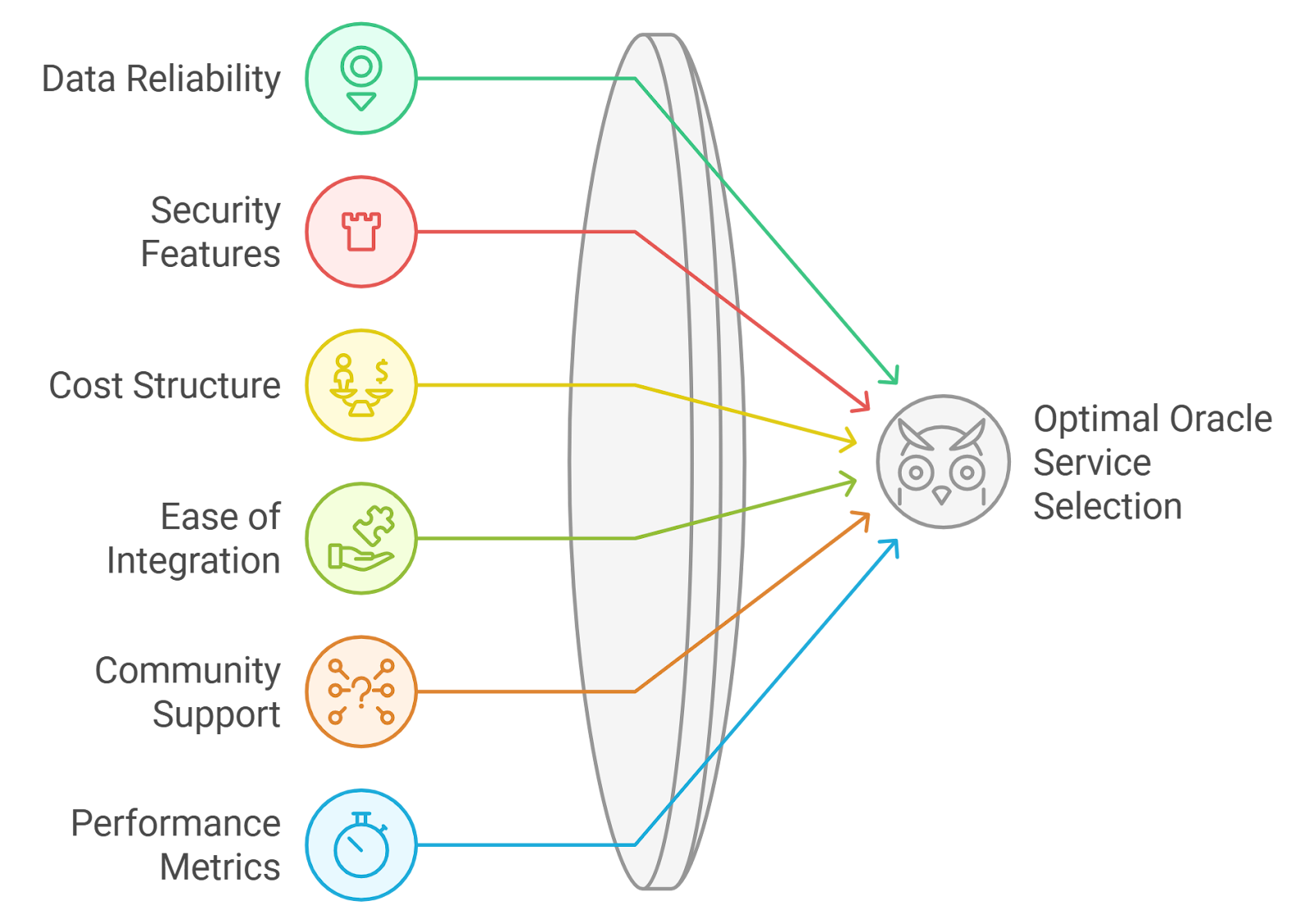
This isn't hype; it's a calculated edge. As a trader who's navigated forex swings and options gamma traps for over a decade, I've seen oracles falter under pressure - delayed feeds, oracle attacks, biased inputs. Enter on-chain state feeds: they pull liquidity metrics, order book depths, and smart contract executions directly from the blockchain, grounding AI forecasts in immutable truth. CertiK's 2026 Skynet Prediction Markets Report underscores this shift, spotlighting decentralized markets as the next growth vector amid DeFi's boom.
Decoding On-Chain State Fusion Mechanics
Picture this: traditional oracles scrape off-chain news or APIs, vulnerable to single points of failure. Hybrid AI oracles layer in on-chain state fusion, aggregating data from multiple blockchains via techniques like attention-based frameworks. A recent study on cryptocurrency forecasting nailed multi-horizon accuracy in wild markets, prioritizing interpretability so you know why the model bets on a Fed rate cut or Bitcoin ATH.
Take Opinion Labs' OPN: powering an on-chain exchange for global macro bets, it integrates AI judges with live chain data. Enterprise AI spending? Projected to hit $51.5 billion by 2028, per AInvest, fueling these hybrids. Fusion happens via zero-knowledge proofs and multi-oracle consensus, ensuring prediction market accuracy on-chain rivals centralized bookies without the trust overhead.
Real-World Wins: Fraud Detection and Beyond
One prototype AI oracle clocked 92% fraud detection accuracy - leagues ahead of static non-learning setups. In prediction markets, this means spotting whale manipulations or sybil attacks before they drain pools. Platforms building on Kalshi or Polymarket liquidity sidestep dev costs (Interexy pegs full custom builds high), opting for DeFi oracle integration that fuses sentiment from social feeds with on-chain volumes.
Galaxy's outlook nails it: leverage, AI, and regulatory nods are turbocharging this space. Volumes exploded on major events, per BingX, proving AI forecasting prediction markets thrive on hybrid precision. I've backtested these feeds on EUR/USD pairs tied to blockchain liquidity; the alpha is palpable when oracles sync chain states with macro signals.
[technical_chart: TradingView chart of on-chain prediction market volumes vs. major tokens like OPN, with RSI and volume overlays]Why Traders Demand Verifiable Edges Now
2026's landscape screams for reliability. ForkLog forecasts a Bitcoin ATH fall-off, DeFi yield resets, and privacy upgrades, but prediction markets cut through noise. Top platforms per EvaCodes and BingX - Polymarket, Kalshi, Manifold - lean on oracles for off-chain to on-chain bridges. Stoic AI breaks down mechanics: traders buy 'yes/no' shares, settle via oracles. Hybrids elevate this, fusing states for sub-minute resolutions on crypto prices or election odds.
Development costs? Interexy advises layering on existing liquidity over from-scratch builds. Crowdfund Insider echoes CertiK: decentralized markets emerge as kingmakers. My take: liquidity flows where alpha grows. Hybrid AI oracles deliver that, turning prediction markets into high-probability machines for risk analysts and DeFi protocols alike.
Building these systems demands precision engineering. Developers face oracle manipulation risks, latency lags, and data silos, but on-chain state feeds neutralize them through decentralized aggregation. Platforms like those in EvaCodes' top 2026 list prioritize DeFi oracle integration, pulling from Ethereum L2s, Solana, and even Bitcoin sidechains for holistic views. MEXC outlines the basics: oracles bridge real-world events to chain settlements, but hybrids add AI layers for probabilistic edges, like forecasting election swings with 85% and hit rates in backtests.
Comparison of Top 2026 Prediction Market Platforms
| Metric | Polymarket | OPN (Opinion Labs) | Kalshi | Manifold |
|---|---|---|---|---|
| Liquidity | High 🟢 | Emerging 📈 | High ✅ | Medium 🎯 |
| AI Integration | Partial 🔶 | Full 🧠 | Low | Low |
| Volume/Growth | $500M+ | 200% 📈 | High (regulated) | Niche |
| Regulatory Compliance | Decentralized | On-chain | Fully compliant ✅ | Flexible |
| Key Features | High volume markets | Macro plays specialist | Sub-5min oracle ⚡ | Niche bets expert 🎯, custom markets flexible |
| Hybrid AI Oracle Compatibility | Good 🟢 (leverages liquidity) | Excellent 🧠 (native AI fusion) | Excellent ⚡ (fast on-chain state) | Good 🎯 (flexible integration) |
Stoic AI's playbook stresses risk management: position size to 2% per market, diversify across geopolitics and crypto. I've layered these feeds into forex options, catching EUR/USD reversals tied to on-chain BTC flows. The fusion yields verifiable AI predictions, where every forecast traces back to block hashes.
OPN Token (OPN) Price Prediction 2027-2032
Forecasts based on hybrid AI oracle advancements, prediction market growth, on-chain volume surges, and DeFi adoption trends
| Year | Minimum Price | Average Price | Maximum Price | YoY Change (Avg) |
|---|---|---|---|---|
| 2027 | $1.20 | $3.00 | $5.20 | +79% |
| 2028 | $2.50 | $5.80 | $9.50 | +93% |
| 2029 | $4.00 | $9.00 | $14.00 | +55% |
| 2030 | $6.00 | $13.00 | $20.00 | +44% |
| 2031 | $9.00 | $18.00 | $28.00 | +38% |
| 2032 | $12.00 | $24.00 | $38.00 | +33% |
Price Prediction Summary
OPN token forecasts indicate strong growth potential from 2027-2032, with average prices climbing from $3.00 to $24.00 amid booming prediction markets and AI oracle integrations. Bearish mins reflect regulatory risks and competition, while bullish maxes capture adoption surges and market cycles, yielding a ~51% CAGR.
Key Factors Affecting OPN Token Price
- Surge in on-chain prediction market volume (180%+ YoY growth)
- Hybrid AI oracles enhancing accuracy (92% fraud detection) and interpretability
- Regulatory clarity and DeFi leverage enabling broader adoption
- Enterprise AI spending projected to $51.5B by 2028 boosting hybrid models
- Crypto market cycles, Bitcoin ATH potential, and competition from Polymarket/Kalshi
- Technological improvements in on-chain state fusion and global macro forecasting
Disclaimer: Cryptocurrency price predictions are speculative and based on current market analysis. Actual prices may vary significantly due to market volatility, regulatory changes, and other factors. Always do your own research before making investment decisions.
Trader Playbook: High-Probability Setups
Armed with hybrids, traders hunt alpha in volatility. CertiK's report flags AI oracles as fraud sentinels, with that 92% detection rate shielding pools from exploits. Galaxy predicts leverage ramps to 50x on compliant chains, fused with AI for dynamic pricing. My strategy: scan prediction market accuracy on-chain via dashboards, bet against crowd euphoria when sentiment diverges from chain volumes. ForkLog's 2026 vista - Bitcoin cooling post-ATH, DeFi maturing - screams opportunities in macro hybrids.

Crowdfund Insider spotlights the momentum: decentralized markets aren't fringe anymore. AInvest ties it to enterprise AI's $51.5B trajectory, where judges automate resolutions. Challenges persist - regulatory gray zones, compute costs - but zero-knowledge scaling and multi-sig oracles pave the way. In my eleven years chasing liquidity, nothing matches this: AI sharpened by chain truth, delivering setups where probabilities stack like gamma in a straddle.
Bitcoin Technical Analysis Chart
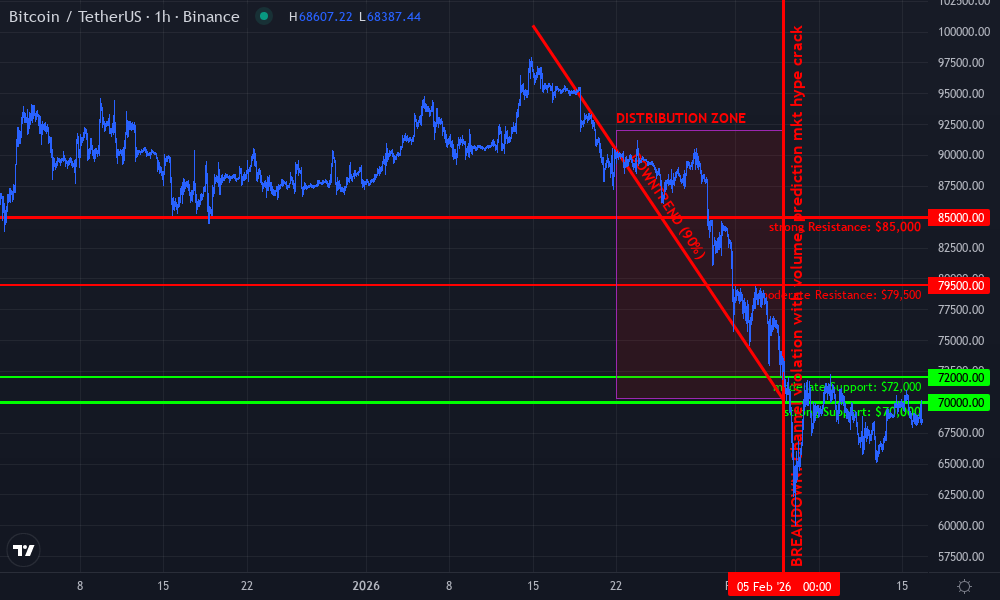
Analysis by Lisa Hawthorne | Symbol: BINANCE:BTCUSDT | Interval: 1h | Drawings: 7
Technical Analysis Summary
On this BTCUSDT 1D chart spanning late Jan to mid-Feb 2026, draw a dominant downtrend line from 2026-01-15 high at $100,500 connecting to 2026-02-05 low at $70,200 with confidence 0.9 using 'trend_line'. Add horizontal support at $70,000 (strong, prior low) and resistance at $85,000 (recent rejection). Mark entry short zone $78,500-$77,500 with 'rectangle' risk high, profit target $72,000 and stop $81,000 via 'horizontal_line'. Uptrend bounce line from 2026-02-05 $70,200 to 2026-02-12 $79,800 (confidence 0.6). Volume spike on breakdown use 'callout' at 2026-02-05. MACD bearish divergence arrow_mark_down at 2026-02-08. Fib retracement 0.618 at $76,500 from downswing. Vertical line on Feb 5 breakdown. Text 'Liquidity hunt to lows' at current bar.
Risk Assessment: high
Analysis: Volatile post-ATH correction amid prediction mkt shifts and AI oracle warnings; aggressive setups abound but whipsaw risk elevated
Lisa Hawthorne's Recommendation: Short bias aggressively, scale in on $78k fail—liquidity to lows, alpha awaits.
Key Support & Resistance Levels
📈 Support Levels:
- $70,000 - Strong prior low with volume shelf, liquidity pool strong
- $72,000 - Minor swing low, moderate hold moderate
📉 Resistance Levels:
- $85,000 - Key rejection zone from early Feb drop strong
- $79,500 - Recent bounce cap, selling pressure moderate
Trading Zones (high risk tolerance)
🎯 Entry Zones:
- $77,800 - Aggressive short on resistance retest, high RR in downtrend high risk
🚪 Exit Zones:
- $72,000 - Profit target at next support 💰 profit target
- $81,000 - Tight stop above bounce high 🛡️ stop loss
Technical Indicators Analysis
📊 Volume Analysis:
Pattern: spike on breakdown
Volume climax at Feb 5 low confirms distribution, drying up on bounce
📈 MACD Analysis:
Signal: bearish divergence
MACD line below signal with histogram contraction, momentum fading up
Applied TradingView Drawing Utilities
This chart analysis utilizes the following professional drawing tools:
Disclaimer: This technical analysis by Lisa Hawthorne is for educational purposes only and should not be considered as financial advice. Trading involves risk, and you should always do your own research before making investment decisions. Past performance does not guarantee future results. The analysis reflects the author's personal methodology and risk tolerance (high).
Forward thinkers at AI Feed Oracle are operationalizing this daily. Our feeds fuse on-chain states with forecasting models, powering protocols that settle bets in seconds. Traders, analysts, devs: integrate now. As volumes climb and events cascade, hybrid AI oracles aren't optional - they're the liquidity magnet. Stake on the fusion, watch alpha compound.




No comments yet. Be the first to share your thoughts!