
2026 Regulatory Landscape Overview
The year 2026 marks a definitive split in global AI governance, creating a dual-track reality for enterprises. On one side, the European Union has transitioned from drafting to hard law enforcement. On the other, the United States continues to rely on policy frameworks and executive guidance rather than comprehensive statutory bans. This divergence forces companies to manage two distinct compliance philosophies simultaneously.
The EU’s Enforcement Phase
The EU AI Act is now the primary regulatory force in Europe. With transparency rules taking effect in August 2026, the focus has shifted from initial risk categorization to strict operational compliance. The regulation imposes mandatory obligations on high-risk AI systems, particularly regarding data governance, human oversight, and transparency. Companies must now align their technical documentation and audit trails with these statutory requirements or face significant penalties. The EU’s approach is prescriptive, leaving little room for interpretation regarding prohibited practices and high-risk safeguards.
The US Framework Approach
In contrast, the United States has opted for a more flexible, policy-driven model. The White House’s National Policy Framework for Artificial Intelligence, released in March 2026, outlines legislative priorities and voluntary best practices rather than imposing rigid federal bans. This framework emphasizes innovation and industry self-regulation, focusing on areas like algorithmic accountability and deepfake protections. While less punitive than the EU model, it creates a complex patchwork of state-level laws and sector-specific guidelines that enterprises must monitor closely.
Strategic Implications
For global organizations, this split requires a bifurcated compliance strategy. The EU’s hard law demands upfront investment in technical controls and documentation, while the US approach requires agile monitoring of evolving policy signals and state-level mandates. Understanding this duality is essential for managing liability and maintaining market access in both jurisdictions.
EU AI Act enforcement phases
The European Union’s AI Act moves from legislative text to active enforcement in 2026. The first major wave of rules arrives in August, targeting transparency and high-risk systems. Companies operating in Europe must align their AI governance with these new requirements or face significant penalties.
August 2026: Transparency and High-Risk Rules
The second phase of the AI Act introduces strict obligations for providers and deployers of high-risk AI systems. These rules require detailed technical documentation, data governance, and human oversight mechanisms. Providers must ensure their systems are robust, accurate, and cyber-secure before they reach the market.
Simultaneously, new transparency rules take effect. Users must be informed when they are interacting with AI, such as chatbots or deepfakes. This includes clear labeling of AI-generated content to prevent deception. Minimal or no-risk AI systems remain largely unregulated, allowing for innovation in low-stakes applications.
The European Commission’s official regulatory framework outlines these phased requirements. Early preparation is essential for enterprises relying on AI for critical operations, hiring, or customer interactions. The focus is on accountability and risk mitigation rather than outright bans.

US executive orders and policy framework
The United States has moved away from relying solely on voluntary industry guidelines. Instead, the federal government is establishing a structured legislative path through the White House National Policy Framework and Executive Order 14365. This shift signals a transition from advisory best practices to enforceable regulatory standards for artificial intelligence.
On March 20, 2026, the White House released the National Policy Framework for Artificial Intelligence. This document outlines specific legislative recommendations designed to standardize AI development and deployment across critical sectors. The framework emphasizes algorithmic accountability, data privacy, and the prevention of discriminatory outcomes in automated decision-making systems.
Executive Order 14365 operationalizes these recommendations by directing federal agencies to update their procurement and compliance requirements. Agencies must now vet AI tools for security risks and bias before integration into government operations. This top-down approach ensures that federal adoption of AI sets a precedent for private sector compliance.
The combination of the framework and the executive order creates a unified national strategy. Companies operating in the US must align their AI governance with these federal standards to avoid legal exposure. This regulatory clarity helps businesses manage the complex landscape of emerging AI laws.
Enterprise compliance strategy steps
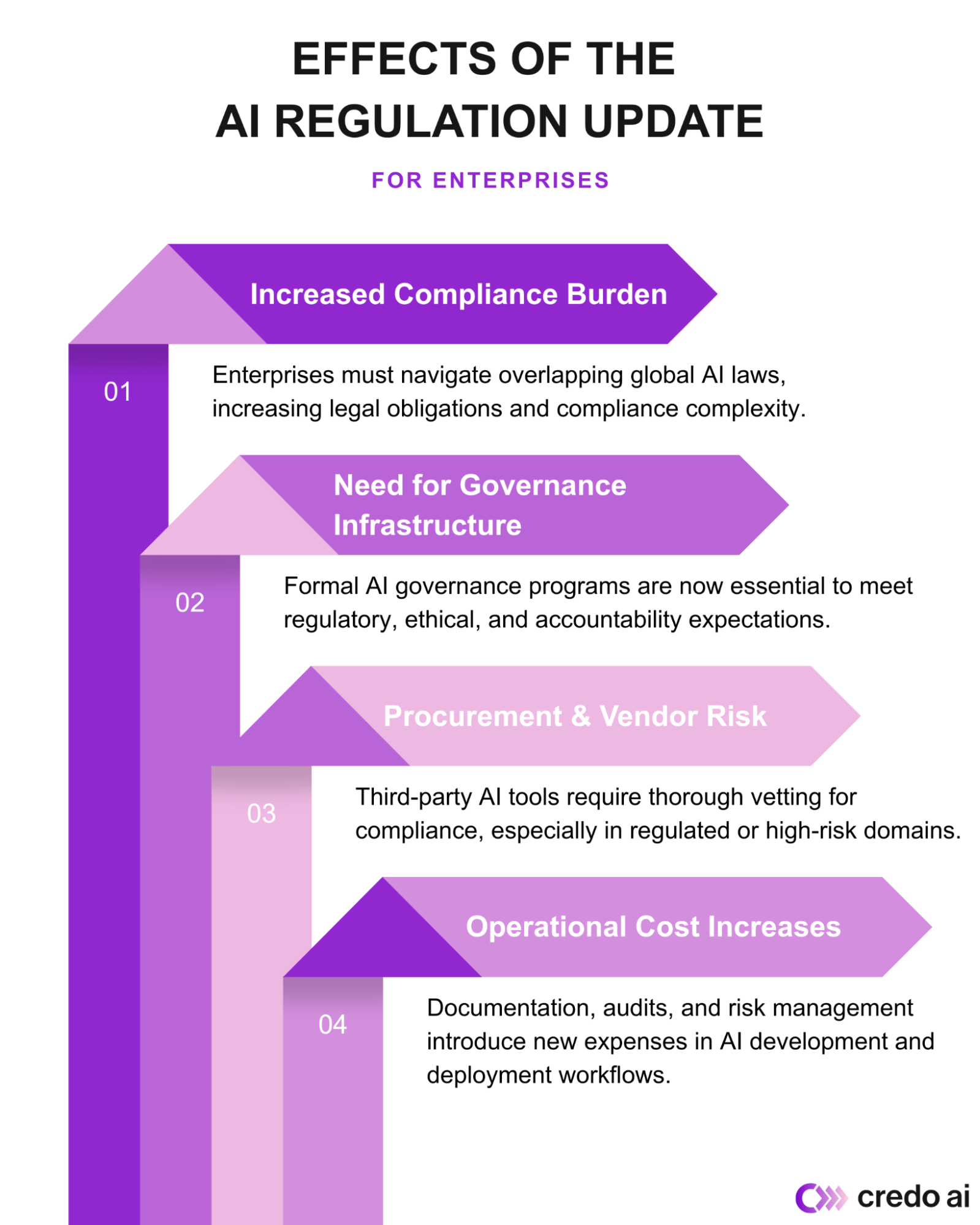
Aligning your AI governance with the 2026 regulatory landscape requires a structured approach. With the EU AI Act and US Executive Orders setting distinct but overlapping standards, enterprises must move beyond high-level policy statements to concrete operational changes. This sequence guides legal and engineering teams through the critical phases of compliance, from initial risk mapping to ongoing monitoring.
Begin by cataloging every AI model in production. The EU AI Act mandates risk classification based on intended use. Identify systems that fall into prohibited or high-risk categories, such as those used in hiring, credit scoring, or critical infrastructure. This inventory is the foundation for all subsequent compliance efforts.

For high-risk AI systems, perform a Fundamental Rights Impact Assessment (FRIA) under the EU AI Act. This process evaluates potential harms to individuals, including bias and discrimination. In the US, align this with the NIST AI Risk Management Framework to document safety and security testing results.
Ensure your engineering teams maintain detailed technical documentation. This includes data governance records, model performance metrics, and decision-making logs. The EU AI Act requires deployers to keep records for at least six months to facilitate post-market monitoring and regulatory audits.
High-risk AI systems must include human oversight capabilities. Design interfaces that allow human operators to intervene, override, or stop automated decisions. This is a core requirement of the EU AI Act and a best practice for US compliance to mitigate liability and ensure accountability.
Compliance is not a one-time event. Implement systems to monitor AI performance and detect drift or anomalies in real-time. Establish protocols for reporting serious incidents to regulators within mandated timeframes, such as 15 days under the EU AI Act. Regular audits should verify that these monitoring systems are effective.
| Requirement | EU AI Act | US Executive Order |
|---|---|---|
| Risk Classification | Mandatory (Prohibited/High/Limited/Minimal) | Voluntary (NIST Framework) |
| Impact Assessment | Fundamental Rights Impact Assessment (FRIA) | Voluntary (Risk Management) |
| Documentation | Technical Documentation & Logging | Voluntary (Testing Results) |
| Human Oversight | Mandatory for High-Risk | Encouraged (Best Practice) |
This structured approach ensures that your enterprise remains compliant with both EU and US regulations. By treating compliance as an ongoing operational discipline rather than a static checklist, you can mitigate legal risks while fostering responsible AI innovation.
No comments yet. Be the first to share your thoughts!