
The shift from chatbots to agents
For years, enterprise AI has been defined by the chatbot: a tool that answers questions based on retrieved data. While useful for information retrieval, this model is fundamentally passive. It waits for a prompt, processes text, and returns a response. It does not act. In 2026, the ROI shift comes from moving to agentic workflows, where AI systems take initiative, make decisions, and exert control over multi-step processes without constant human intervention.
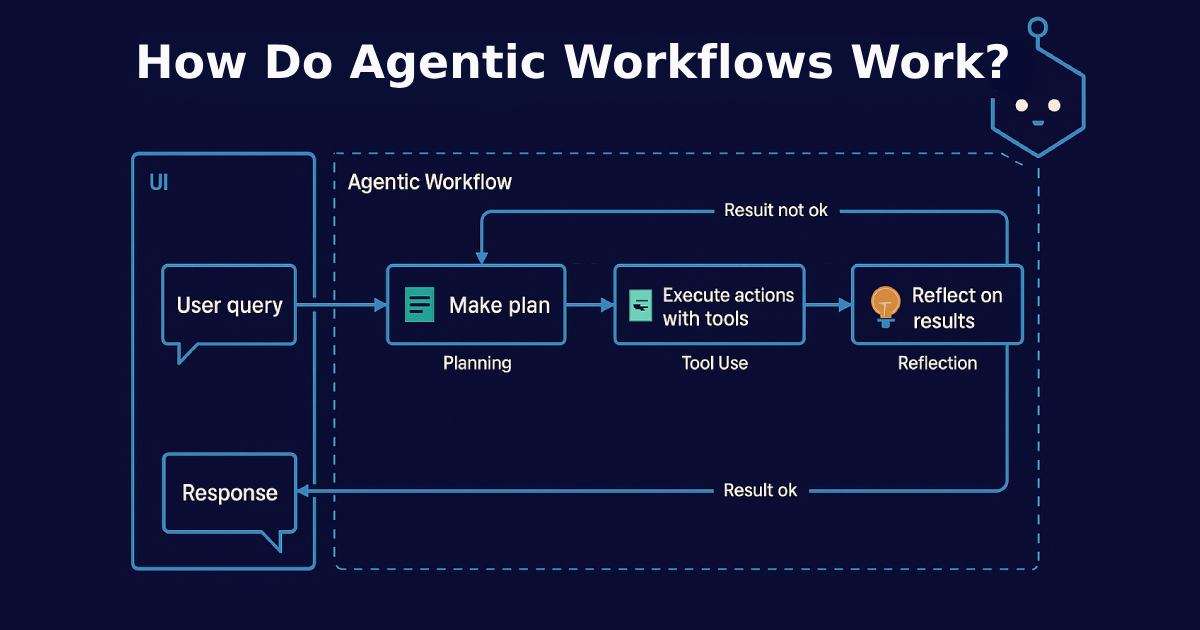
The structural difference is architectural. A chatbot is a single-turn or limited-context loop. An agentic workflow is a closed-loop system involving planning, tool use, and execution. According to Vellum.ai, an agentic workflow is a system that uses AI to take initiatives, make decisions, and exert control at various stages in the process. This allows the system to handle complex, multi-step tasks—such as reconciling financial discrepancies or updating CRM records—by breaking them down and executing them autonomously.
This shift changes the value proposition from information access to operational execution. Enterprises are no longer paying for answers; they are paying for completed actions. This requires a different evaluation of ROI, focusing on task completion rates and error reduction rather than query response times. To understand the market context for this technology, we can look at the broader performance of the enterprise AI sector.
Core agentic workflow patterns
Simple prompt-response models fail when tasks require multi-step reasoning or external data. Agentic workflows solve this by introducing a control loop around the model. Instead of a single generation pass, the agent plans, acts, observes the result, and iterates. This shift from static outputs to dynamic execution is the foundation of enterprise ROI.
The architectural pattern chosen dictates latency, cost, and reliability. Below is a comparison of the three most critical patterns for 2026 deployments.
| Pattern | Complexity | Latency | Best Use Case |
|---|---|---|---|
| ReAct | Low | Low | Fact-checking, simple tool use |
| Plan-and-Execute | Medium | Medium | Multi-step research, document drafting |
| Reflection Loop | High | High | Code generation, complex reasoning |
The ReAct (Reason + Act) pattern is the baseline for agentic behavior. The model interleaves thought and action in a tight loop, allowing it to correct errors immediately. It is lightweight and fast, making it ideal for tasks like fraud detection where speed is paramount.
Plan-and-Execute separates the workflow into two distinct phases. The agent first generates a structured plan, then executes each step. This reduces context window bloat and improves consistency for longer tasks, such as compiling quarterly financial reports.
The Reflection Loop adds a self-critique step. After generating an output, the agent evaluates its own work against predefined criteria and revises it. This pattern is essential for high-stakes tasks where accuracy is non-negotiable, such as legal contract review or code deployment.

Choosing the right pattern depends on the trade-off between speed and accuracy. ReAct offers speed with lower reliability. Reflection Loop offers high accuracy with higher latency. Most enterprise systems use a hybrid approach, starting with ReAct for simple queries and escalating to Reflection Loop for complex, high-value tasks.
Measuring enterprise AI ROI 2026
The financial narrative for agentic workflows has shifted from experimental cost centers to measurable revenue drivers. In 2026, enterprises are no longer asking if AI can perform tasks, but rather how autonomous agents compress the cycle from insight to action. This shift is quantifiable through three primary metrics: operational efficiency gains, error reduction, and direct revenue attribution.
Efficiency gains in agentic workflows stem from the automation of complex, multi-step processes that previously required human handoffs. Unlike traditional automation scripts that follow rigid rules, agentic systems can navigate unstructured data and make contextual decisions. This capability allows marketing and finance teams to reallocate labor from execution to strategy. Recent market analyses suggest that organizations deploying autonomous agents for high-volume tasks, such as campaign optimization or financial reconciliation, are seeing efficiency multipliers that far exceed initial projections. Some early adopters in marketing have reported ROI figures approaching 836% by eliminating manual data entry and real-time bid adjustments.
Error reduction is the second pillar of ROI. Human error in data processing, compliance reporting, and customer service responses carries a significant hidden cost. Agentic workflows reduce these errors by applying consistent logic across millions of transactions. This consistency not only lowers the cost of remediation but also improves customer trust and regulatory compliance. The financial impact is often reflected in reduced chargebacks, fewer compliance penalties, and lower operational overhead.
The transition from insight to action is where the most significant value is captured. Traditional AI models provide recommendations; agentic workflows execute them. This distinction matters for ROI because it removes the latency between decision and implementation. For example, an agentic system can analyze market data and adjust pricing strategies in real time, capturing value that would be lost if a human had to manually review and approve the change. This immediacy is particularly valuable in volatile markets where timing is critical.
To track these metrics, enterprises are moving beyond simple cost savings calculations. They are adopting frameworks that measure the speed of decision-making and the quality of autonomous outcomes. This requires robust data infrastructure and clear KPIs that align with business objectives. Without this alignment, the ROI of agentic workflows remains abstract and difficult to justify to stakeholders.
Choosing the Right Model for Autonomous Agents
Selecting the underlying model is the most critical architectural decision for agentic workflows. In 2026, the gap between general-purpose language models and specialized agentic engines has widened significantly. The choice hinges on three factors: tool-use precision, context window stability, and reasoning consistency under load.
GPT-5.4 remains the baseline for complex, multi-step reasoning. Its strength lies in handling ambiguous instructions and recovering from minor tool-calling errors. However, its cost per token is higher, and latency can spike during long-horizon tasks. Claude Opus 4.6 offers superior instruction following and lower latency for structured tool calls, making it ideal for high-frequency, deterministic workflows. Gemini 3.1 Pro excels in multimodal integration, particularly when agents need to interpret visual data or long documents alongside text.
The table below compares these models on key agentic metrics based on current benchmark data.
| Model | Tool Use Precision | Context Stability | Relative Cost |
|---|---|---|---|
| GPT-5.4 | High | High | High |
| Claude Opus 4.6 | Very High | Medium | Medium |
| Gemini 3.1 Pro | High | Very High | Low |
For finance and high-stakes applications, tool-use precision is non-negotiable. A model that hallucinates a function call parameter can cause data corruption or financial loss. Claude Opus 4.6 currently leads in this category, with GPT-5.4 close behind. Gemini 3.1 Pro is catching up rapidly but still shows occasional inconsistencies in complex, multi-tool chains.
Consider your workflow's primary bottleneck. If latency is the issue, Claude Opus 4.6 is the stronger choice. If context window size is the constraint, Gemini 3.1 Pro offers the best value. For maximum reasoning depth where cost is secondary, GPT-5.4 remains the gold standard.
Implementation checklist for 2026
Start by auditing current workflows to identify high-friction, repetitive tasks suitable for automation. Map these processes to specific agentic patterns, such as autonomous loops or human-in-the-loop reviews, to ensure clear boundaries between AI autonomy and human oversight.
Identify repetitive, rule-based tasks with clear success metrics. Document current bottlenecks and define the exact handoff points between human operators and AI agents.
Choose between simple task automation or complex multi-agent orchestration. Start with single-agent solutions for isolated tasks before scaling to interconnected systems that require cross-departmental coordination.

Launch the agent in a sandboxed environment with real data but limited scope. Monitor error rates, latency, and decision accuracy closely, adjusting prompts and constraints based on initial performance.
Measure ROI against baseline metrics before full-scale deployment. Ensure robust governance frameworks are in place to handle edge cases and maintain compliance with enterprise security standards.
No comments yet. Be the first to share your thoughts!